How to Create SEO-Friendly Content That Ranks on Google and AI Search
Introduction
The digital marketing landscape is changing rapidly. Earlier, businesses primarily focused on ranking their websites on Google’s search engine results pages. Today, the way people search for information has evolved. Users are increasingly relying on AI-powered platforms such as ChatGPT, Google AI Overviews, Gemini, and Perplexity to find answers, compare products, and discover services.
This shift has made SEO (Search Engine Optimization) more important than ever. However, traditional SEO alone may not be enough to build strong online visibility. Businesses now need to optimize their content for search engines as well as AI-powered search platforms.
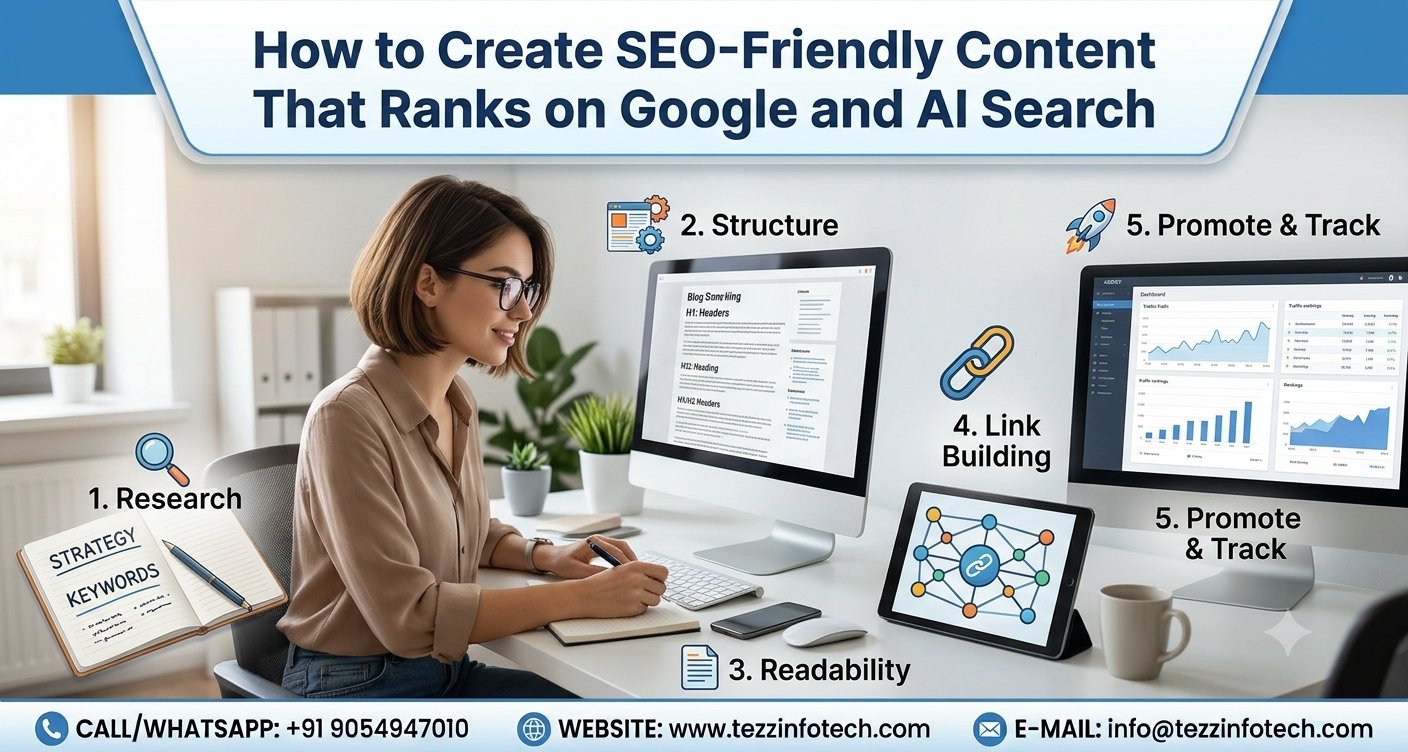
Creating SEO-friendly content means developing valuable, informative, and well-structured content that answers users’ questions while following search engine best practices. With the right combination of SEO, AEO (Answer Engine Optimization), and GEO (Generative Engine Optimization), businesses can improve their chances of being discovered across multiple digital platforms.
In this blog, we will explore how to create SEO-friendly content that ranks on Google and improves visibility in AI search results.
1. Understand Your Target Audience and Search Intent
Before writing any content, it is important to understand your target audience. You need to identify what people are searching for, what problems they want to solve, and what information they expect to find.
Search intent refers to the reason behind a user’s search query. Generally, it can be divided into four categories:
- Informational intent: Users want to learn something or find answers.
- Navigational intent: Users are searching for a specific website or brand.
- Commercial intent: Users are researching products or services before making a decision.
- Transactional intent: Users are ready to purchase or hire a service.
For example, someone searching for “How does SEO work?” has informational intent, while someone searching for “Best SEO Services for small businesses” has commercial intent.
Understanding search intent helps you create relevant content that satisfies users’ expectations and increases the possibility of ranking in search results.
2. Perform Effective Keyword Research
Keyword research is one of the most important steps in creating SEO-friendly content. It helps you understand which terms your potential customers are using when searching online.
Instead of targeting only high-volume keywords, focus on relevant keywords that match your business goals and audience needs.
For example, if you provide digital marketing and AI solutions, you can target keywords such as:
- Best SEO Services
- Best AI Services
- SEO-friendly content writing
- AI search optimization
- Google ranking strategies
- Generative Engine Optimization
- Answer Engine Optimization
- SEO content strategy
- AI-powered digital marketing
Use keyword research tools to identify search volume, keyword difficulty, related search terms, and search intent.
Include your primary keyword naturally in important locations such as:
- Blog title and introduction
- Relevant headings and subheadings
- Meta title and meta description
- Image alt text, where appropriate
- URL structure
- Conclusion
Avoid keyword stuffing. Search engines prioritize helpful and relevant content rather than pages that repeatedly use the same keyword.
3. Create High-Quality, Helpful and Original Content
High-quality content is the foundation of successful SEO. Search engines aim to provide users with relevant, reliable, and helpful information.
Your content should solve a problem, answer a question, or provide meaningful insights. Avoid writing articles simply to include keywords or increase word count.
Follow these practices when creating content:
Provide valuable information: Explain the topic clearly and offer practical advice that readers can apply.
Use original insights: Include your own expertise, examples, research, and experiences instead of rewriting information from other websites.
Write in simple language: Use clear sentences and avoid unnecessary technical jargon.
Keep information updated: Review older content and update statistics, examples, tools, and recommendations.
Answer important questions: Include the questions your target audience frequently asks about the topic.
For example, when discussing the Best SEO Services, explain what SEO services include, how they help businesses, and what factors companies should consider before choosing an SEO provider.
Helpful content builds trust with readers and provides stronger opportunities for visibility across traditional and AI-powered search platforms.
4. Optimize Content for Google’s Search Engine
Traditional SEO remains an essential part of digital marketing. Even with the growth of AI search, Google continues to be an important source of website traffic.
To improve your content’s search engine performance, focus on the following elements:
On-Page SEO
On-page SEO involves optimizing individual website pages to make their content easier for search engines and users to understand.
Important elements include:
- SEO-friendly page titles.
- Descriptive meta descriptions.
- Proper H1, H2, and H3 heading structures.
- Relevant internal links.
- Descriptive image alt attributes.
- Clean and readable URLs.
- Natural keyword placement.
Technical SEO
Technical SEO ensures that search engines can access, crawl, and index your website effectively.
Important technical SEO practices include:
- Improve website loading speed.
- Make your website mobile-friendly.
- Implement HTTPS security.
- Create and submit an XML sitemap.
- Fix broken links and crawl errors.
- Use structured data where appropriate.
- Avoid duplicate content issues.
A technically optimized website creates a better user experience and supports your overall SEO strategy.
5. Optimize Content for AI Search Engines (GEO)
Generative Engine Optimization (GEO) is the practice of improving content so that it has a better chance of being understood, referenced, or cited by AI-powered search experiences.
Platforms such as ChatGPT, Gemini, and Perplexity generate answers using information from different sources. Creating clear, reliable, and well-organized content can improve its suitability for these experiences, although no strategy guarantees AI citations.
Consider these GEO practices:
Write clear and direct answers: Start important sections with concise explanations that directly address the heading.
Use descriptive headings: Organize information into meaningful sections that make the topic easy to understand.
Include reliable information: Support factual claims with credible sources and relevant evidence.
Build topical authority: Publish interconnected articles that cover different aspects of your industry.
Strengthen brand identity: Maintain consistent business information, service descriptions, and brand references across your website.
Use real examples: Include practical examples, case studies, and original insights wherever possible.
For example, an article about digital marketing services should explain SEO, AI marketing, content optimization, and their business benefits in separate, clearly structured sections.
These practices can make your content more useful to both human readers and AI-powered systems.
6. Implement AEO to Improve Answer Visibility
Answer Engine Optimization (AEO) focuses on making website content easier to use for direct answers in search experiences.
Many users now search using conversational questions such as:
- What are the benefits of SEO?
- How can I improve my Google rankings?
- Which are the Best SEO Services for businesses?
- How can AI improve digital marketing?
To optimize for AEO, include relevant questions and provide concise answers.
For example:
Question: What are SEO-friendly content strategies?
SEO-friendly content strategies involve keyword research, search intent analysis, helpful content creation, on-page optimization, internal linking, and regular content updates. These practices help search engines understand content and provide a better experience for readers.
You can also create an FAQ section at the end of your blog. Use structured data only when it accurately represents the visible content and follows Google’s eligibility guidelines.
7. Use AI Tools to Improve Content Creation
Artificial intelligence is transforming the way businesses research, create, optimize, and analyze website content.
AI tools can help content marketers and SEO professionals work more efficiently. However, AI-generated content should always be reviewed and improved with human expertise.
Some useful applications of AI include:
- Generating blog topic ideas.
- Finding related keyword opportunities.
- Creating content outlines.
- Improving grammar and readability.
- Identifying content gaps.
- Summarizing research.
- Analyzing content performance.
Businesses looking for the Best AI Services should consider solutions that support their actual business requirements, including workflow automation, AI-powered customer support, data analysis, and content optimization.
Remember that using AI does not automatically improve search rankings. The quality, originality, accuracy, and usefulness of the final content matter most.
8. Build Strong Internal and External Links
Links help search engines discover content and understand relationships between different pages.
Internal linking connects related pages within your website. For example, a blog about SEO-friendly content can link to your pages about keyword research, technical SEO, content marketing, and digital marketing services.
External linking connects your content to relevant and trustworthy sources.
Follow these linking practices:
- Link to relevant pages on your website.
- Use descriptive anchor text.
- Reference authoritative sources for factual claims.
- Avoid irrelevant or excessive links.
- Review broken links regularly.
A well-planned internal linking strategy improves website navigation and helps search engines understand your website structure.
9. Focus on E-E-A-T and Brand Authority
Google’s quality evaluation framework includes Experience, Expertise, Authoritativeness, and Trustworthiness (E-E-A-T).
Although E-E-A-T is not a single direct ranking factor, demonstrating these qualities can help establish credibility and improve the overall quality of your website.
You can strengthen your content’s credibility by:
- Adding author information and relevant expertise.
- Publishing original case studies.
- Including genuine customer testimonials.
- Providing accurate company information.
- Citing reliable research and industry sources.
- Keeping business contact details updated.
- Demonstrating practical knowledge of your industry.
For businesses offering the Best SEO Services and Best AI Services, building a trustworthy online presence is particularly important because customers want to understand the company’s expertise before making a decision.
10. Measure Content Performance and Update Regularly
Publishing a blog is only the beginning. You should regularly measure its performance to understand whether your content is achieving its goals.
Use tools such as Google Analytics 4 and Google Search Console to monitor:
- Organic website traffic.
- Keyword impressions and clicks.
- Average search positions.
- Click-through rates.
- User engagement.
- Conversions and inquiries.
- Indexing and technical issues.
For AI search visibility, also monitor relevant brand mentions and citations across AI platforms using available measurement tools and manual checks. AI answers can vary, so avoid relying on a single search or visibility score.
Review your articles periodically and update outdated information, add useful insights, improve internal links, and address new user questions.
Continuous optimization helps keep your content relevant as search behavior and technology evolve.
Conclusion: Grow Your Online Visibility with Tezz Infotech
Creating SEO-friendly content that performs well on Google and AI search platforms requires a strategic combination of traditional SEO, Answer Engine Optimization, and Generative Engine Optimization. Businesses must focus on understanding search intent, conducting effective keyword research, publishing helpful content, improving technical SEO, and building brand authority.
As search technology continues to evolve, businesses that invest in quality content and modern digital marketing strategies can create stronger opportunities for online visibility.
If you are looking to improve your website rankings, strengthen your digital presence, or explore AI-powered business solutions, Tezz Infotech can be your technology and digital growth partner.
With a focus on SEO strategies, digital innovation, and AI-driven solutions, Tezz Infotech aims to help businesses strengthen their online presence and adapt to the changing digital landscape.
Choose the right strategy today and prepare your business for the future of Google and AI search.
Frequently Asked Questions (FAQs)
1. What is SEO-friendly content?
SEO-friendly content is informative, well-structured content optimized to rank on search engines and provide value to readers.
2. How do I create SEO-friendly content?
Conduct keyword research, understand search intent, write helpful content, optimize headings, add internal links, and update content regularly.
3. Why is keyword research important for SEO?
Keyword research helps identify the search terms your target audience uses and improves content relevance.
4. What is Generative Engine Optimization (GEO)?
GEO is the practice of optimizing content to improve its chances of being referenced or cited by AI-powered search platforms.
5. What is Answer Engine Optimization (AEO)?
AEO focuses on structuring content to provide clear and direct answers to users’ questions.
6. Does AI-generated content help improve SEO rankings?
AI-generated content can support SEO when it is accurate, original, helpful, and reviewed by human experts.
7. How can Tezz Infotech help improve SEO performance?
Tezz Infotech offers SEO strategies and AI-driven solutions to help businesses strengthen their online presence and digital visibility.